

Presenting as an autistic person: Public speaking is often cited as a highly common fear, but for people with autism, this challenge goes far beyond typical stage fright. For decades, training has focused on “fitting in,” pressuring neurodivergent speakers to mask their natural traits and appear “normal.”
It is time to move beyond this deficit-based model. By adopting a neurodiversity-affirming approach, we can define effective presenting as authentically sharing a unique perspective. Here are five strategies that will allow you to leverage your natural superpowers.
Many people on the spectrum possess an exceptional ability to deliver in-depth monologues on topics they are passionate about. This is the advantage of monotropism, which allows for immense substantive depth.
Instead of suppressing your expert knowledge, recognize it as your greatest asset.
Treat writing a presentation script as a strength. It allows for formal, precise, and technical expression, ensuring accuracy without depleting cognitive resources by spontaneously navigating through content and the meanders of social rules. Thanks to this, your presentation will also be thoughtful and deeper. The greatest speeches in history were always meticulously written down first and only delivered later.

The requirement for eye contact is often the most difficult part of public speaking and communication for people with autism. For a presenter with autism, visual stimuli coming from the audience’s faces are intense, asynchronous data that compete with the brain’s speech-generation process. Eye contact can also cause discomfort and a kind of intimidation. For many people, eye contact is synonymous with closeness and intimacy.
One comfortable method of maintaining eye contact for a person with autism is looking at the spot between the eyes. This gives the listener the feeling of being heard and noticed, while you don’t experience it as such an intense and intimate contact.
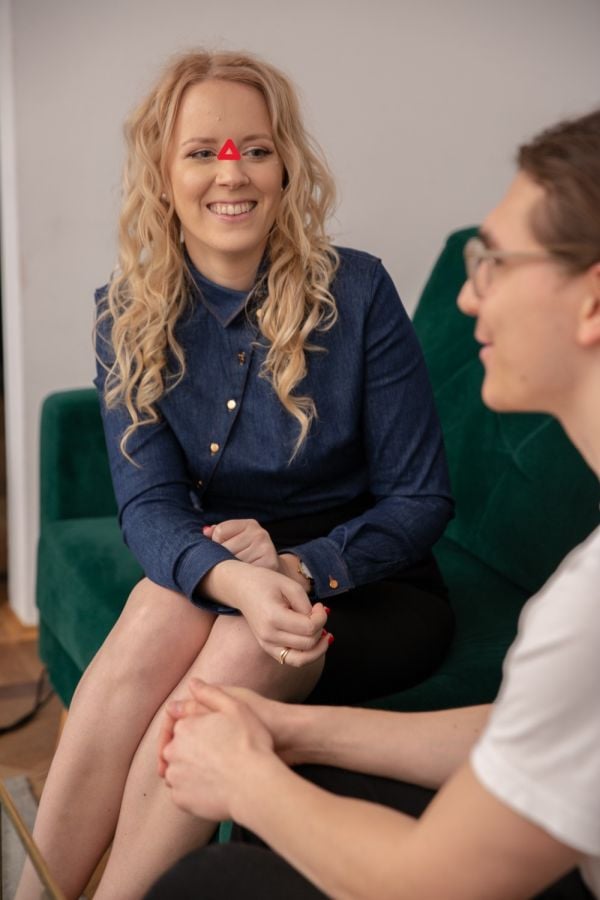
You can also use the “looking through” technique, which means imagining that you are not looking into their eyes, but at what is behind them.
Maintaining eye contact with your listener or audience for about 70% of the time will be sufficient.
The good news is that you can practice this until it becomes a kind of habit and you do it automatically.
If you feel you have reached your limit of looking someone in the eyes, use a lifeline that will look natural. By focusing on a fixed point or visual aids, you reduce sensory overload. This could be an outline or slides that you see in front of you on a laptop.

Communication should rely on various channels. This helps the audience absorb knowledge and also makes your task easier. Even individuals who communicate very effectively verbally can experience a temporary loss of speech during sensory overload or burnout.
Use tablets or multimedia presentations to play pre-recorded technical sections, or use apps that will help you introduce interactive elements and relieve the pressure on you in the meantime (e.g., Menti or Slido).
Create a schedule or simply a slide outline to manage the flow of the presentation and reduce the anxiety of transitioning between topics.
A good practice, regardless of being neurotypical or neurodivergent, is using visualizations. To make this task easier for your listeners and yourself, remember to add photos, icons, and symbols when discussing more complex issues.

Time for data processing is a fundamental requirement for clear communication. In a professional environment, a strategic pause is an act of self-care by the presenter, but also a gift to the audience, who needs time to process what you have said.
Adopting a slower pace gives your brain the space to organize complex thoughts and choose the right words.
Don’t feel forced to conform to the presumed expectations of a neurotypical audience. Slowing down the pace prevents communication errors and helps maintain emotional regulation. Besides, slowing down and pausing build an image of someone wise and professional. Don’t be afraid of silence!

While neurotypical communication often relies on “unwritten rules” and metaphors leading to ambiguity, a presenter on the autism spectrum offers something unique: clarity.
In technical environments, avoiding ambiguous language is a significant professional advantage because it prevents many costly mistakes that result from a lack of precision and understatement.
If the audience finds your style too direct, remember that this is a mutual mismatch, not your deficit. A precise message is the standard for a professional relationship. Of course, it is worth learning how to reach different audiences, as this increases your professional opportunities.

Effective communication is not about playing “normal.” The double empathy problem teaches us that the burden of establishing a connection does not rest solely on the speaker. A successful presentation happens when the audience meets the speaker halfway, respecting their need for processing time, visual support, and directness.
Click here if you want to learn how to present and communicate better as a person with autism. Send me a message to get more information about the program, working methods, and pricing.

Author:
Hi, I’m Magda Kern. I’m a psychologist, the top 11 public speaking coach worldwide, a lecturer, working for companies from the Fortune 500 list, a business trainer with 12 years of experience, a TEDx coach, and an ex-vocalist based in Switzerland. I help people prepare and deliver unforgettable presentations and deal with stress.
Added to cart
Check out our shop to see what's available
