
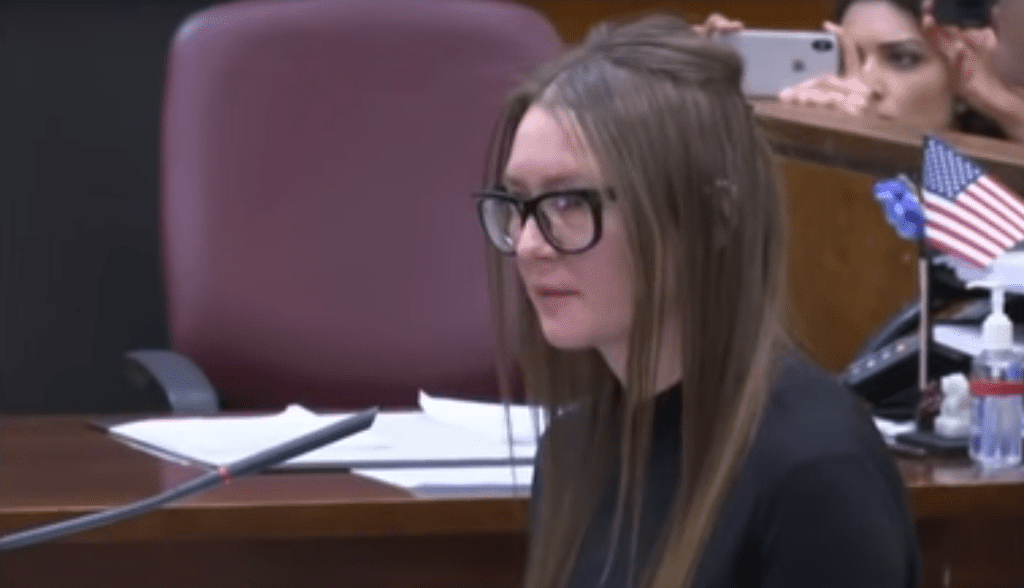
Anna Sorokin became widely known thanks to the Netflix series Inventing Anna, which tells the story of Anna Delvey, played by Julia Garner, and her rise into New York’s elite. How was it possible for a 25-year-old to deceive so many influential people and obtain such large sums of money? In this article, I look at the techniques shown in the series, which is a dramatised version of real events, and explain the psychological mechanisms behind them.
Anna repeatedly asks: “Do you know who I am?” She demands special treatment and expects everyone to “know their place”. She sets the pattern of behaviour she expects from others, and if someone doesn’t follow it, she pushes them aside.

Having “important” friends in many circles is a ticket into the world of the elite. Glamour and popularity have attracted admirers of this lifestyle for centuries. In Anna’s case, a well-known psychological effect was at work: social proof. Two scenes illustrate it well. In the first one, the owner of a gallery refuses to get involved in her business because he doesn’t know her or trust her. In the second, once Anna has entered this world, the same man says in the same office: “I didn’t know you knew these people… Of course I’ll invest.” Connections act as a kind of guarantee: if others have already trusted someone, it seems safe for us to trust them too.
The saying “show me your friends and I’ll tell you who you are” is very true and works on our subconscious. In many industries, the only way to get a job is through referrals. What’s the lesson for us? It’s worth thinking carefully about who we surround ourselves with.
Anna also builds the image of someone who is constantly busy, using the scarcity principle, which is often used in dating as well. We want what is unique, rare and hard to get. Spending time with Anna could make people feel special: such a busy and important person had found time especially for them!

In moments of confrontation, Anna plays on emotions. For example, when a friend refuses to let her stay the night, Anna brings out the big guns and hints that she might take her own life if left alone. She also uses phrases such as: “You’re my last resort”, “I thought you were my friend”, “It’s all because of my father” or “The bank messed up an international transfer”. For a sensitive and empathetic person, such phrases can trigger guilt and sympathy, which lead them to do what Anna wants.
The critical situation in which her friend Rachel faces losing her job and enormous debt shows how Anna strung her along for almost three months, repeatedly giving her hope that the bank transfer was about to arrive. It never came, yet Anna kept her friend believing that the money was on its way.

In the scene where her friends confront Anna about not returning the more than $60,000 she owes Rachel, Anna insists she will pay it back soon. When her friends reveal that they know the truth, she turns the tables and starts attacking them. She doesn’t admit any guilt, blames the bank for incompetence and then accuses the women of pettiness.
In the interview she gave after her release from prison, Anna keeps a blank expression when answering difficult questions. She shows no hesitation when she says she doesn’t regret what she did and doesn’t care what others think of her. Her body language shows a lot of self-confidence. Her voice is very light and girlish, which contrasts with her facial expression, which at many moments shows contempt. Her laughter doesn’t seem genuine, as the corners of her mouth and eyes don’t lift.

According to media reports, Anna’s goal was to do something spectacular and become famous. After serving her sentence, she gained a large following on social media, and her story became the basis of a Netflix series. Did she achieve what she wanted? In part, certainly. But the price was high, both for her and for the people she deceived.
The mechanisms Anna used are not manipulative in themselves. What matters is how and why we use them. Speakers can use them ethically to build trust with their audience. Social proof works when you show testimonials, client logos or examples of projects you’ve worked on. Self-presentation helps when you briefly mention your experience and qualifications at the start of your talk. Scarcity can be a fair argument only if it’s true, for example when a workshop really has a limited number of places. And as listeners, knowing these mechanisms helps us recognise when someone is trying to manipulate us.
Let’s stay in touch. Contact me to get more information about the program, working methods, and pricing.

Author:
Hi, I’m Magda Kern. I’m a psychologist, the top 11 public speaking coach worldwide, a lecturer, working for companies from the Fortune 500 list, a business trainer with 12 years of experience, a TEDx coach, and an ex-vocalist based in Switzerland. I help people prepare and deliver unforgettable presentations and deal with stress.
Added to cart
Check out our shop to see what's available
