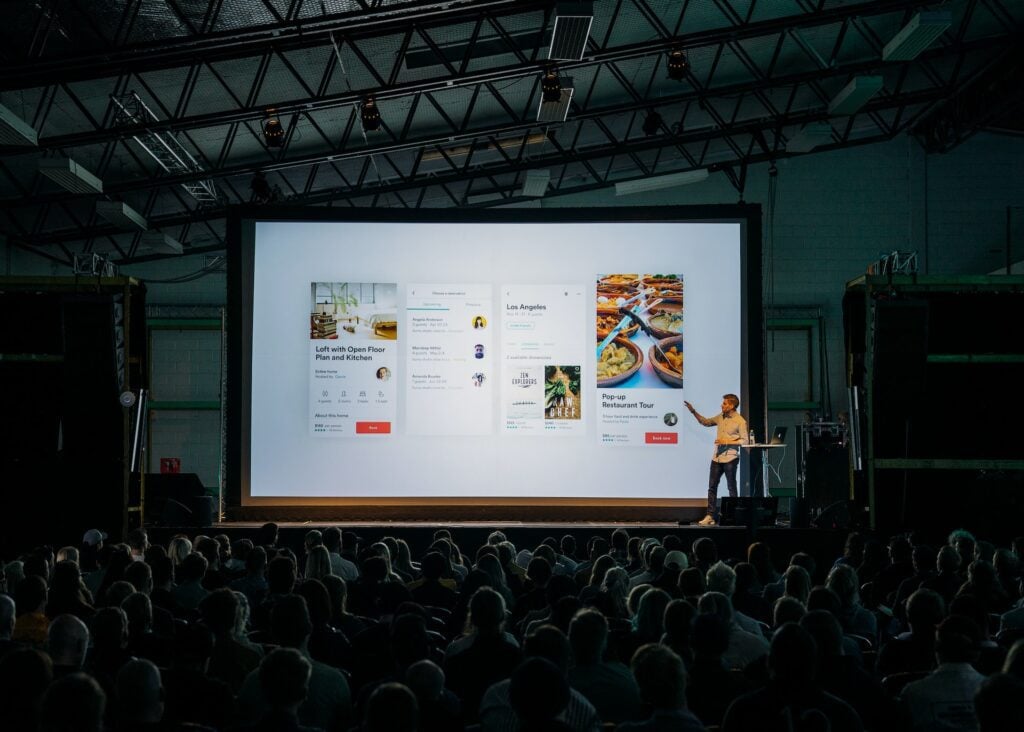
How to pitch? What are the rules of creating a business pitch?
The “must-have” list for your pitch. How to create a professional pitch?
Think about your pitch from the audience's perspective
What is important to them?
Why did they come to listen to you?
What could be valuable to them?
Investors or clients are primarily interested in their own benefit, not your ego or the effort you put into the project. Ask yourself a simple question: “What’s in it for my audience?” Instead of talking about a complex production process, focus on what specific problem you are taking off their minds.
Example– instead of saying “We have created an advanced AI algorithm based on neural networks for data analysis”, say: “Thanks to our tool, your team will save 5 hours a week on doing tedious reports”.
Practice makes perfect
If the content of your pitch is well-practiced, your stress level will be lower, and you will be more confident on stage, making it easier to convince the audience.
Stage fright often comes from uncertainty, so the more times you practice your performance, the more natural you will sound. Test your pitch on friends, your partner, or even speaking to a mirror. After the third delivery, you will notice where you get stuck, and after the tenth, you will start playing with the text and pace.
How can you practice? Turn on a stopwatch on your phone, record your presentation on video, and watch it. When you see yourself on the recording repeating “uhh” 15 times or fidgeting in place, you will immediately catch the habits you need to improve.
Think about which words are necessary and which ones can be cut
Time on stage when you pitch flies relentlessly. Get rid of all industry jargon and filler adjectives that add no value. State every value proposition straight to the point, without beating around the bush. If a word doesn’t bring new, key information, press “delete” without regret.
Example– Instead of the sentence: “Our innovative, comprehensive, and highly synergistic system effectively optimizes procurement processes”, write briefly: “Our software cuts company purchasing costs by 15%“.
Engage the audience using, for example, a question or a call to action
A pitch shoudn’t be a boring academic lecture, but an engaging interaction where you have to snap people out of their daydreaming and fight for their attention. How? For example, by asking a question that triggers an immediate impulse to listen to you. At the end, provide a call to action (what should happen next) so they know what the next step is.
Example– Start with an unusual question: “How many of you spent more than 30 minutes in traffic this morning?”, and then end the pitch with something concrete, e.g.: “Go to our website and test the free version of the app today.”
A strong start will capture the audience's attention
You have a few seconds to get people to look up from their smartphone screens. Skip the boring greeting like “Hi, my name is John Smith and I’m going to tell you about project X,” because that will put the audience to sleep right off the bat. Start with something surprising that they don’t expect. Our brain loves that! For example, a shocking statistic, a catchy anecdote, or a controversial thesis.
Example–“Every minute companies throw millions down the drain due to poor management, but we know how to get that money back.”
Do something differently than others
Investors and judges listen to dozens of similar presentations a day, so you have to break the routine. You can use a prop, play with a deliberate pause, or tell a short story with an unexpected twist. The point is for them to remember you after a long day, rather than the twentieth identical Canva presentation in a row.
Example– Pull a sock with a hole in it out of your pocket, show it to everyone, and say: “This is exactly what the current security system looks like in 90% of small businesses.”
Learn the text by heart
Then focus on the delivery: body language, gestures, pace, volume, clear pronunciation, breathing, movement on stage, and eye contact with the audience.
When you know the text by heart and don’t have to think about the next word, you free up your brain’s processing power for pure expression. Only then do you gain the space to maintain eye contact, control your breath, and emphasize key information with pauses. Remember that your posture and energy also contribute to how your pitch will be evaluated.
Test the 1-minute and 3-minute versions
Shortening your presentation is the best test of whether you truly understand your own idea. In a one-minute version, there is no room for details because only the absolute essence remains: the problem, the solution, and the business model. If you can captivate someone in 60 seconds, you will easily handle a longer format.
Be a star
Let the presentation be a supporting actor. For a short presentation, a few slides are enough.
Slides are meant to be a visual booster for your words, not a cheat sheet for you to read full sentences from. People came to listen to you and evaluate your charisma and passion, not to read walls of text on a screen. For a short pitch, 1–2 high-quality slides are more than enough.
Display just one large, expressive product photo or a simple chart showing 300% growth, while you tell the entire thrilling story yourself.
Leave the audience wanting more
Accept the fact that you can’t cover everything or dive into fine details. Once you intrigue the audience, they will come to you to hear more. The goal of a short pitch isn’t to sign a contract or close a deal on stage, but to spark curiosity.
If you try to cram your entire tech stack and financial model into a few minutes, you’ll only bore and overwhelm your listeners. Keep a few aces up your sleeve so the audience genuinely wants to approach you during networking behind the scenes.
Let’s connect. Send me a message to receive more information about the program, methods, and pricing.
Author:
Hi, I’m Magda Kern. I’m a psychologist, the top 11 public speaking coach worldwide, a lecturer, working for companies from the Fortune 500 list, a business trainer with 12 years of experience, a TEDx coach, and an ex-vocalist based in Switzerland. I help people prepare and deliver unforgettable presentations and deal with stress.